
Table of Contents
The promise of sports psychology is simple: you can train your mind the same way you train your body. Just as a sprinter repeats starts or a setter drills footwork, a competitor can rehearse breath control, cue words, and reset rituals until they become automatic. In this model, confidence is not an emotion that appears when we feel lucky; it is the side effect of rehearsing the right actions in the right order. For Filipino athletes, that mindset protects energy during long tournaments and turns community support into laser-focused execution.
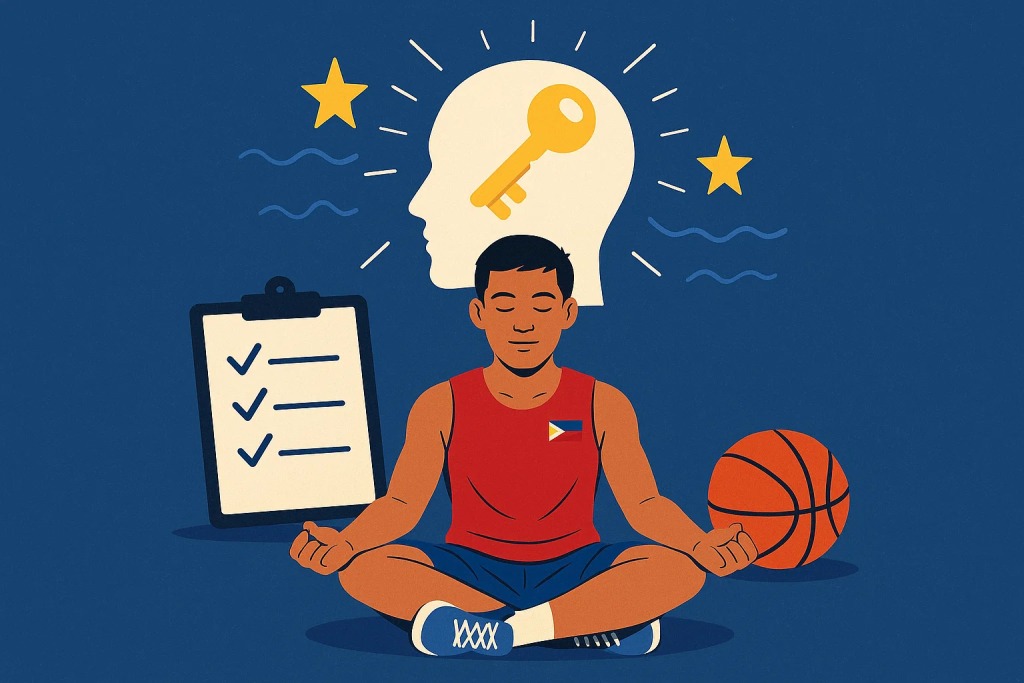
Filipino athletes compete in courts, gyms, rings, tracks, pools, and digital arenas where noise is constant and pressure feels personal. Winning in these environments is not only about muscles or mechanics; it is about attention, composure, confidence, and recovery under stress. That is why sports psychology has moved from an optional talk on the eve of a finals match to a daily toolkit that any player, coach, or parent can learn. This long-form guide translates research and practice into checklists, scripts, and routines tailored to Philippine realities—crowded schedules, tropical heat, travel delays, and the proud, joyful culture that powers our teams.
Why mental preparation is a competitive edge in 2025
Seasons are tighter, competitions are streamed, and fans expect access to players from warm-up to cool-down. The result is continuous scrutiny. Under those lights, sports psychology gives athletes tools to manage arousal, filter noise, and return quickly to the next task after a mistake. The more chaotic the venue, the more valuable clean routines become.
Travel also introduces fatigue and uncertainty: delayed buses, sticky locker rooms, missing balls, last-minute schedule changes. Instead of treating these as signs of doom, a team can use them as chances to practice adaptability. By embedding sports psychology into scouting, warm-ups, and postgame debriefs, coaches reduce panic and amplify trust.
The Filipino edge—community, grit, and joy
Filipino players take pride in pakikisama (social harmony), bayanihan (collective effort), and saya (joy). These cultural strengths can become mental superpowers when structured well. A team that sings during warm-ups is not being unprofessional; it is lowering arousal and synchronizing rhythm. A family that stays involved is not a distraction; it is a social battery if boundaries are clear. Sports psychology blends these natural strengths with evidence-based exercises so that the joyful athlete is also the composed athlete.
Five pillars for Filipino performance
A program that scales from barangay to national team needs clarity. We can group the mental game into five pillars: Identity, Attention, Emotion, Communication, and Recovery. Each pillar connects to familiar plays and can be trained in ten-minute blocks.
Identity means knowing who you are when the score swings; Attention means pointing your focus where it matters; Emotion means riding the wave without wiping out; Communication means sending and receiving clear signals under fatigue; Recovery means resetting faster than the opponent. Together, these pillars turn sports psychology into a repeatable system instead of a one-off pep talk.
Pillar 1: Identity—your anchoring story
Write a one-page Competitive ID: three strengths you bring, three behaviors that express them, one red flag that shows you are drifting, and one reset ritual to come back. Read it each Monday; share one line with a teammate. This small act converts sports psychology from theory into shared language.
Quick prompts to fill the page:
- “When I am under pressure, I still…”
- “Teammates can count on me to…”
- “If I notice ___, I am drifting; I reset by…”
- “My point of pride that does not depend on the score is…”
Pillar 2: Attention—the three-step micro routine
Filipino competitions are loud. You cannot silence the crowd, but you can spotlight the cues that matter. Use a three-step routine before every serve, shot, lift, or attempt: a zoom-in cue word, a four–six breath, and a single-action commitment. When practiced daily, this micro routine becomes the metronome of sports psychology.
Examples by sport:
- Basketball free throw: “front rim”—inhale 4, exhale 6—“snap.”
- Volleyball serve receive: “toss”—breath—“platform.”
- Boxing entry: “angle”—breath—“jab.”
- Weightlifting first pull: “brace”—breath—“drive.”
- Esports clutch: “target”—breath—“click.”
Pillar 3: Emotion—accept, name, and channel
Fear and anger are not enemies; they are energy sources. The goal is not to feel nothing; it is to feel and still choose the next right action. Breath ladders, progressive release, and short self-talk scripts keep the body available to execute. This is the emotional hygiene of sports psychology.
Regulators you can teach in ten minutes:
- Breath ladder: 4–2–6–2 (inhale–hold–exhale–hold) for two minutes.
- Progressive release: tense fists five seconds, release; repeat shoulders, jaw, calves.
- Self-talk scripts: short, present, controllable—“strong base,” “soft eyes,” “finish high.”
- If–then plans: “If I feel anger after a call, then I look at the floor line, breathe once, and refocus on my cue word.”
Pillar 4: Communication—Green Talk and huddle maps
Many Filipinos avoid blunt criticism to preserve harmony. In games, that can delay necessary corrections. Create Green Talk: one verb and one noun—“Close middle,” “Protect angle,” “Low hips.” Pair that with hand signals and pre-planned huddles so that communication remains calm and precise. These are behavioral bricks of sports psychology.
Huddle map recipe:
- Who speaks first.
- One thing to repeat.
- One thing to remove.
- One first action on the whistle.
Pillar 5: Recovery—between-play resets
Matches are decided between actions. Build a 20–30 second reset: long exhale, eyes on the horizon, a cue word for the next task, posture check. Resetting faster than your opponent is a quiet advantage delivered by sports psychology and it costs nothing but attention.
Reset checklist:
- Exhale longer than inhale.
- Unclench jaw and drop shoulders.
- Widen vision (see corners of the court).
- Say the next-action verb.
A 12-week Filipino mental training plan
Weeks 1–4 (Foundation): write Competitive ID; install the attention routine; practice breath ladders; journal two lines per day—what worked and what to repeat. Weeks 5–8 (Pressure): add crowd noise, scrimmages with consequences, five-minute Green Talk drills, and a weekly video session. Weeks 9–12 (Polish): simulate travel fatigue, rehearse interviews, and formalize a celebration habit. Every step speaks the language of sports psychology while respecting local culture and constraints.
Weekly rhythm example:
- Mon: Identity refresh + attention reps 10 minutes.
- Wed: Emotion regulators + scrimmage with noise.
- Fri: Communication and huddle maps.
- Sat: Reset timing drill + journaling.
Skill menus for popular sports
Basketball: free-throw routine (bounce, breath, word, shoot); end-game huddles with five words max; switch maps for screens.
Volleyball: server ID cards, libero resets after shanks, hitter cue words on approach.
Boxing: corner codes that cover defense, distance, and a single combo; a round reset that is brief and repeatable.
Weightlifting: barbell breath cues, neutral walkaway posture, planned self-talk for each attempt.
Esports: ping pause for lag rage, clarity codes for comms, and 20–20 screen breaks. All of these are simple applications of sports psychology.
Science without the jargon
Under threat, the body narrows vision and floods muscles with tension. Long exhales engage the vagus nerve and downshift arousal; naming a feeling reconnects the prefrontal cortex to motor control; cue words reduce decision load. Those are the physiological reasons sports psychology helps you stay sharp when others spiral. You are not “overthinking”; your brain is trying to keep you safe. Training gives it better options.
Fast facts:
- Breath length affects heart rhythm and focus.
- Labeling emotions lowers limbic grip.
- One cue word beats three sentences.
- Mirror neurons make team calm contagious.
Scaling across schools, clubs, and federations
Treat mental drills like warm-ups: short, non-negotiable, and coach-led. Publish a ten-drill curriculum tied to the five pillars; micro-certify coaches twice a year; map pillars to season phases; track process KPIs such as routine fidelity and reset speed. Once embedded in calendars and scoreboards, sports psychology transforms culture.
Three moves for administrators:
- Add ten minutes of mental work to the official practice plan.
- Fund two coach workshops per year with micro-assessments.
- Put one mental KPI on the monthly dashboard.
Measuring what matters
Use practical indicators: routine fidelity, reset speed, communication errors, and pressure stats (free throws in final minutes, attack efficiency at deuce, accuracy after misses). Review them weekly. When athletes see improvements they own the process, and when coaches see numbers they keep teaching. That loop is sustained by sports psychology rather than charisma alone.
Sample KPIs:
- % of plays preceded by routine.
- Average seconds to reset after an error.
- Misreads per set or quarter.
- Clutch conversion vs. season average.
Common Filipino barriers and fixes
Hiya (shyness) makes sharing fears difficult; let captains go first. Tsismis (gossip) can make honesty risky; set confidentiality rules. Overtraining creeps in; swap ten minutes of physical volume for mental reps instead of stacking more. Access is limited; remember that breath, words, and routines are free. With these adaptations, sports psychology thrives in public schools and pro teams alike.
Barrier busters:
- Anonymous mood check-ins before practice.
- “What worked/Repeat” journals instead of blame lists.
- Role rotation so leaders do not burn out.
A 30-day pressure upgrade challenge
Days 1–7: write Competitive ID; run the attention routine before every drill; practice breath ladders nightly. Days 8–14: install Green Talk; add stakes to scrimmages; time your reset with a phone. Days 15–21: simulate noise and delays; practice interviews; review video twice. Days 22–30: taper volume, rehearse travel and call time, then end sessions with gratitude circles. Finish with a showcase where athletes demonstrate routines. That is how sports psychology becomes a badge of team identity.
Roles and responsibilities
Athletes own routines, sleep, hydration, and two-line journals. Coaches model calm, reward execution over outcome, and use Green Talk. Team leaders manage energy on the bench, protect culture, and follow up on struggling teammates. Parents praise effort and respect recovery windows. Admins schedule workshops, protect days off, and fund coach education. Clarifying roles turns sports psychology from a concept into daily behavior.
Storytelling and heritage
Filipino athletes draw strength from elders, faith, and national symbols. Use pregame rituals that honor mentors, carry a small token of heritage, and record one learning per week. Make rituals simple so they focus attention rather than feed superstition. Connecting purpose to action is a high-octane form of sports psychology.
Game-day calm-down menu
Prepare a personalized list: one-minute nasal breathing, a ten-count body scan, a sip of water and a shoulder roll, the neutral thought “Just this play,” and a quick smile to loosen the jaw. Use the menu during timeouts and delays until your body associates it with steadiness. Repetition is the engine of sports psychology.
Ethics and clinical boundaries
Coaches teach skills; clinicians treat illness. If an athlete shows signs of depression, panic attacks, disordered eating, or trauma responses, refer to licensed professionals. Meanwhile, keep practicing everyday tools—breath, routines, communication—because they support both healing and performance. Ethical clarity is foundational to sports psychology.
The business case for programs
A twelve-week mental curriculum improves retention, reduces conflict, and lifts clutch stats without expensive equipment. Parents appreciate structured routines, teachers see better classroom focus, and sponsors value positive culture. Investing in sports psychology is a budget-friendly way to raise ceilings without overloading schedules.
Match-day blueprint
Night before: visualize first plays for ten minutes, pack gear, sleep early. Morning: light walk, hydration, a note of gratitude to a teammate. Arrival: three exhales, review Competitive ID, set two process goals. Warm-up: run the attention routine before every rep. During play: Green Talk only, quick resets after errors, celebrate small wins. Mid-match: short debrief—what works and what to repeat. Final whistle: same walkaway posture win or lose, two-line journal within an hour. Next day: review process clips and pick cue words for the next practice. Simple beats complicated; that simplicity is the spirit of sports psychology.
Call to action
Start now. Print your Competitive ID, choose a cue word, and practice the 4–2–6–2 breath while commuting. Coaches, pick three drills and make them non-negotiable this week. Administrators, schedule a one-hour workshop and add mental KPIs to next month’s report. The gap is not talent—it is repeatable routines under pressure, and sports psychology gives you the map.
Coach scripts and sideline checklists
Clear language accelerates learning under noise. Use these ready-to-run scripts and adapt them to your sport.
Pre-practice brief (60 seconds): “Theme is first-step focus. Our routine is cue word, four–six breath, single-action commitment. Green Talk all day. We log one win and one repeatable behavior in our journals after.”
Timeout or huddle (30 seconds): “One thing that works, one thing to repeat, one thing to remove. Breathe out, eyes up, posture tall. On the whistle we commit to the first action.”
Postgame wrap (120 seconds): “Name three repeatable behaviors we liked. Pick one clip to study tomorrow. Gratitude to a teammate. Same walkaway posture every time.”
Checklist for assistants: stopwatch for reset time, tally of miscommunications, note of crowd triggers, photo of whiteboard after brief. The assistants hand off their notes to the analyst or teacher so lessons survive beyond the day. Treat these steps like taping an ankle: small, boring habits that prevent big problems.

Parent language pack
Family is a power source for Filipino athletes when boundaries are clear. Share this pack with guardians:
- Replace “Win please” with “Play our routine.”
- Replace “Why did you miss?” with “What did you see and what is the next cue?”
- Replace “You must score” with “Let’s focus on our first action and our reset.”
- After a loss, ask “What will we repeat next week?” not “What went wrong with you?”
Travel and tournament stress hacks
Disruptions are inevitable; plan for them. Pack a small “reset kit”: nasal strip, hand towel, water bottle, journal, and a card with your cue words. Arrive early enough to walk the venue, pick two visual landmarks, and rehearse the first play at game speed. During long waits, switch between five minutes of light movement and two minutes of quiet breathing. Before bed, write a single page: three things that worked, one adjustment, one gratitude.
Injury rehab and the return-to-play mindset
Pain and uncertainty can hijack focus. Name the fear: “I worry about the first sprint” or “I worry about the landing.” Build graded exposures that start small and expand. Celebrate plain, boring days where you simply followed the plan. Keep a mood and sleep log so you catch dips early. Coordinate therapist notes with coach plans so the athlete sees one team, not mixed messages. Indeed.
Frequently Asked Questions
1) Is sports psychology just positive thinking?
No. It is a set of learnable skills—breath control, attention routines, cue words, communication rules, and reset rituals—that help you execute under pressure. Positive thinking without process is fragile; process creates confidence.
2) How often should teams train mental skills?
Three to five short sessions per week, ten to fifteen minutes each. Attach routines to existing drills so habits become automatic and sustainable.
3) Can sports psychology help youth and beginners?
Absolutely. Younger athletes learn fast because habits are not rigid. Simple routines make games less scary and more fun, improving retention and enjoyment.
4) What if a player resists the exercises?
Run a two-week trial and track one stat they care about—free throws, serves in, successful lifts. Let improvement persuade them, and use peer modeling to boost adoption.
5) How do we keep the program going all season?
Post a locker-room checklist, assign leaders to run routines, and review mental KPIs weekly. When it is part of the schedule, it lasts; that is sustainable sports psychology.